
Before you install WPRentals, make sure your hosting account and WordPress setup meet the requirements below.
Using the correct server configuration helps prevent installation errors, demo import failures, slow performance, image upload problems, and Elementor or plugin compatibility issues.
Before Installation
Before installing WPRentals, you must already have the following:
- A hosting account
- A domain name connected to the hosting account
- A working WordPress installation on that domain
Most WordPress hosting companies offer one-click WordPress installation.
If you prefer to install WordPress manually, you can follow the official WordPress installation guide:
We strongly recommend using a quality hosting provider. Demo import, image processing, booking features, map requests, calendar features, and search queries need enough server resources.
Very low-cost hosting plans may fail because of low PHP limits, timeouts, restricted server resources, or limited database performance.
WordPress Requirements
Your hosting should support the current WordPress recommended requirements.
WordPress currently recommends:
- PHP: 8.2 or greater
- Database: MySQL 8.0 or greater, or MariaDB 10.6 or greater
- Web server: Apache or Nginx
- Apache module: mod_rewrite, when Apache is used
- HTTPS / SSL: supported and enabled for live websites
WordPress official requirements
Even though WordPress may still run in some older environments, a modern WPRentals website should use an up-to-date PHP version and a properly maintained database server for better compatibility, performance, and security.
WPRentals Requirements
To use the latest WPRentals theme versions correctly, we recommend the following setup:
- WordPress: 6.0 or higher
- PHP: 8.0 or higher
- Database: MySQL 8.0+ or MariaDB 10.6+ recommended
- HTTPS / SSL: enabled for live websites
If your server uses older software, you may see installation problems, update issues, admin warnings, demo import failures, or Elementor-related errors.
Important: WPRentals may work with PHP 8.0+, but for the best long-term compatibility and security, use a PHP version supported by WordPress and your hosting provider.
Recommended PHP Limits
For WPRentals installation, demo import, image processing, and normal website use, we recommend the PHP limits below.
PHP Time Limit
- max_execution_time: 600
- max_input_time: 600
Some hosting environments also allow scripts to request more execution time with set_time_limit(), but this can be blocked by hosting policy.
PHP Memory Limit
- memory_limit: 256M minimum
- memory_limit: 512M recommended for larger websites, many plugins, translations, or large demo imports
PHP Post Max Size
- post_max_size: 64M or higher
Upload Max Filesize
- upload_max_filesize: 64M or higher
post_max_size must be equal to or higher than upload_max_filesize. If upload_max_filesize is 64M but post_max_size is lower, uploads may still fail.
Max Input Vars
- max_input_vars: 3000 minimum
- max_input_vars: 5000 recommended for websites with large menus, many theme options, or complex forms
If max_input_vars is too low, WordPress may not save large menus, theme options, or form settings correctly.
Common Errors When Limits Are Too Low
If the server limits are too low, you may see errors such as:
- The link you followed has expired during theme or plugin upload
- demo import stops or does not finish
- 500 or 503 errors during demo import
- blank Elementor pages after import
- image upload or image processing errors
- white screen or fatal memory errors
How to install WPRentals theme and included plugins
Recommended PHP Modules
Make sure your server has the common PHP modules needed by WordPress, WPRentals, media uploads, and third-party integrations.
At minimum, we recommend:
- cURL – needed for remote requests and third-party integrations
- XML / XMLReader – needed for XML processing and imports
- DOM – needed by WordPress and plugins that process HTML/XML structures
- mbstring – needed for multibyte text handling
- json – needed for REST API and data exchange
- zip – useful for plugin/theme packages and import/export tools
- gd or imagick – needed for image processing and thumbnail generation
- openssl – needed for secure remote connections
- fileinfo – useful for file type detection
- exif – useful for image metadata handling
If image thumbnails are not generated correctly, make sure either GD Library or ImageMagick is enabled on the server.
If remote requests, API calls, map services, payment gateways, or third-party integrations fail, check that cURL and OpenSSL are enabled.
How to Check Your Hosting Limits
You can check your current server details directly from WordPress.
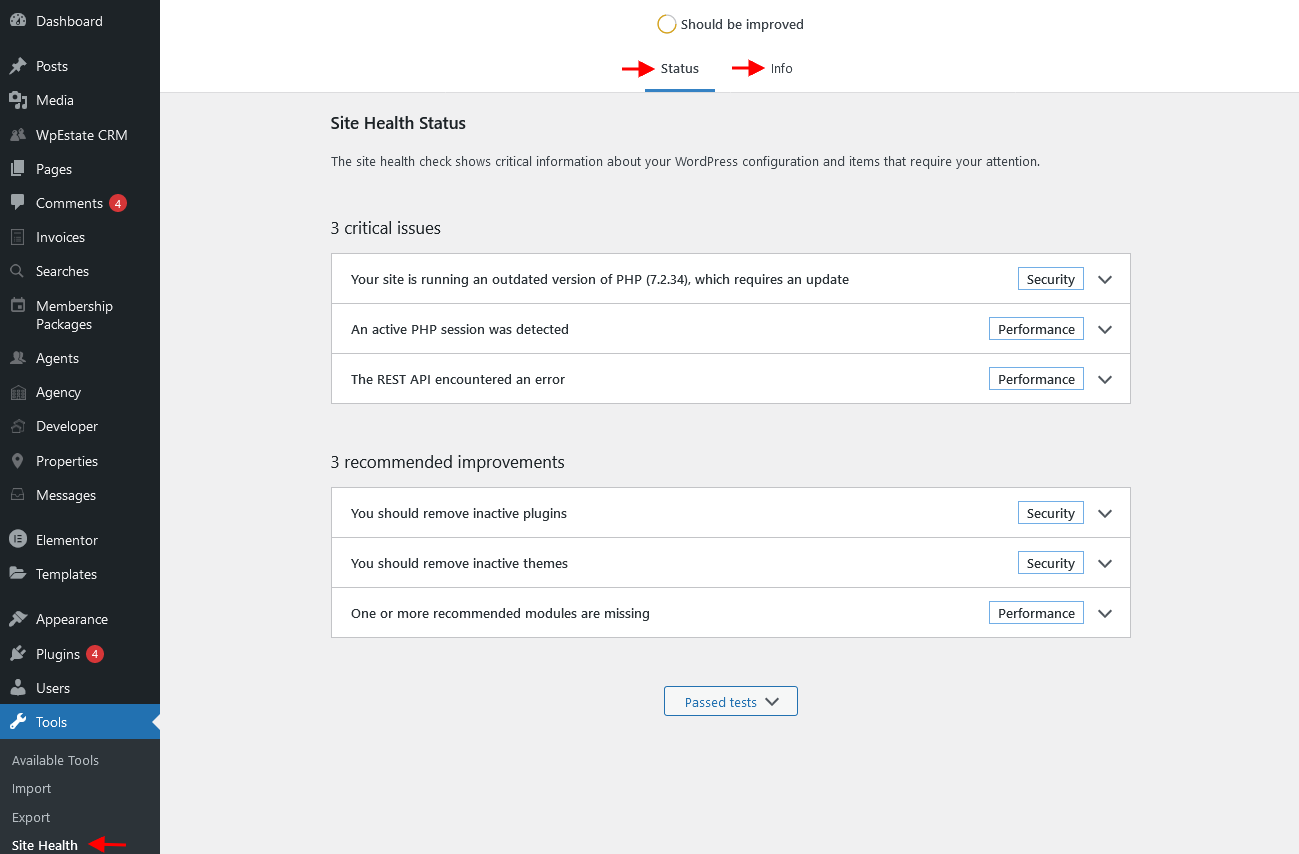
- Go to Tools > Site Health.
- Open the Info tab.
- Expand the Server section.
- Review the PHP version, memory limit, database version, and server configuration.
The WordPress Site Health screen is one of the easiest ways to verify this information from wp-admin.
WordPress Site Health documentation
You can also check server values from your hosting control panel, if your hosting provider shows PHP settings there.
Important Notes
- Always keep the WPRentals theme, WPRentals Core Functionality plugin, and WPRentals Elementor add-on updated together.
- If you use Elementor, do not keep outdated WPRentals theme/plugin versions together with newer Elementor versions.
- If you use a child theme, review custom templates and custom code after major theme updates.
- After updating the theme or plugins, clear browser cache, plugin cache, server cache, and CDN cache if used.
- Before demo import, confirm that the theme license is active and the required plugins are installed and activated.
- Before large demo imports or large media uploads, confirm that PHP limits are high enough.
- HTTPS / SSL should be enabled before using bookings, payments, login/register forms, or user dashboard features on a live website.