
What Are Listing and Owner Link Names?
In WPRentals, the Listing and Owner Links Names options control the URL structure used for listing pages, listing taxonomy pages, and owner pages.
These are not menu links or buttons. They are the words used inside your website URLs.
For example, a URL like this:
https://yourdomain.com/properties/villa-with-pool/
uses properties as part of the permalink structure.
Another example:
https://yourdomain.com/type/apartment/
uses type as part of the URL for a listing taxonomy page.
Changing these link names changes how WPRentals builds these URLs on the front end.
Where to Manage the Link Names
Go to:
Theme Options > General > Listing and Owner Links Names
Change the permalink names as needed and click Save.
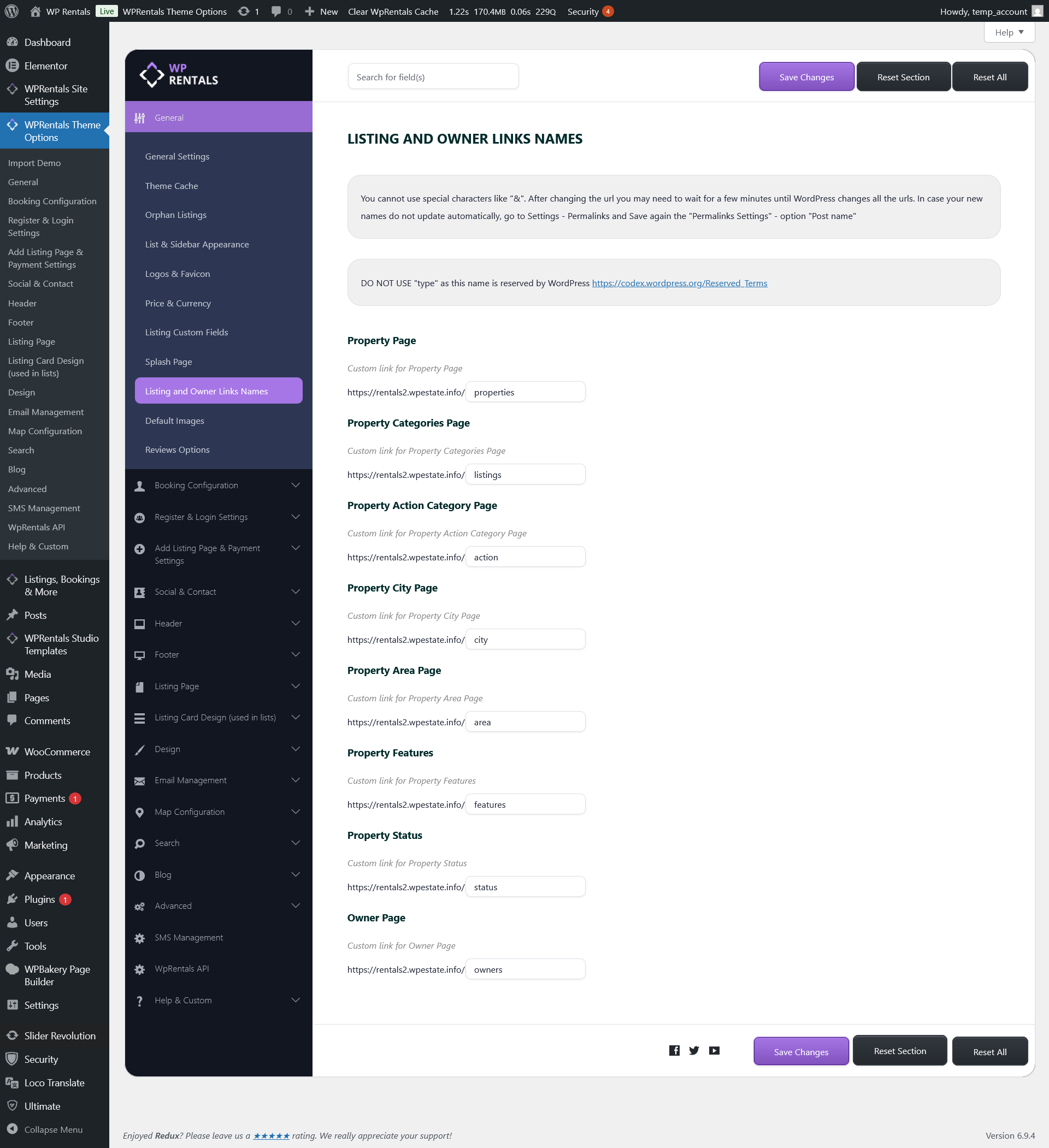
Available Link Names
You can update the custom link names for:
- Property Page – used in the URL structure for individual listing pages.
- Property Categories Page – used for listing category archive URLs.
- Property Action Category Page – used for action category URLs, such as rent or stay.
- Property City Page – used for city archive URLs.
- Property Area Page – used for area archive URLs.
- Property Features – used for listing feature archive URLs.
- Property Status – used for listing status archive URLs.
- Owner Page – used in the URL structure for owner profile pages.
Important Rules Before Changing Link Names
Use simple and unique names for these permalink fields.
Recommended format:
- Use lowercase letters.
- Use numbers only if needed.
- Use hyphens instead of spaces.
- Avoid special characters.
- Do not use the same slug in more than one place.
Good examples:
rentals
all-rentals
holiday-homes
rental-cities
Avoid examples like:
properties!
property page
type
category
Do not use the word type, as it is a reserved term in WordPress.
More information: WordPress Reserved Terms
You should also avoid using the same slug for a regular WordPress page and for a WPRentals permalink name.
For example, if you already have a page with this URL:
/properties/
do not also use properties as an important permalink base for another WPRentals URL structure.
WordPress needs each URL structure to be unique. When the same slug is used in multiple places, WordPress may not know which content should load. This can cause 404 errors, especially on pagination or archive pages.
Save WordPress Permalinks After Each Change
After saving the changes in WPRentals, go to:
Settings > Permalinks
Click Save Changes again, without making any additional edits.
This step is required so WordPress refreshes the permalink structure and applies the new URLs.

After that, visit the front end of your website and test the updated URLs.
Pagination 404 Caused by URL Conflicts
If one page loads correctly, but page 2 or page 3 returns a 404 error, check for a slug conflict.
Example:
This page works:
/properties/
But this page returns 404:
/properties/page/2/
If pagination works correctly on other listing taxonomy pages, such as category, city, area, feature, or status pages, but fails only on one custom page, the issue is usually not a general server permalink issue.
In this case, the page slug may be conflicting with another WordPress or WPRentals URL rule.
To fix it:
- Edit the WordPress page that has the problem.
- Change the page slug to a more specific name.
- Save the page.
- Go to Settings > Permalinks.
- Click Save Changes.
- Clear any active cache.
- Test the pagination again.
For example, change:
/properties/
to:
/all-rentals/
Then test:
/all-rentals/page/2/
If the pagination works after changing the slug, the old slug was conflicting with the permalink rules. Keep the new unique slug.