
Overview
The Multiple Currency Widget in WPRentals allows visitors to switch displayed listing prices to another currency.
This is useful when your website has international visitors who want to view property prices in a currency they understand.
Important: There are two different ways to show the currency selector on the site:
- WordPress Widget: Use Wp Estate – Multiple Currency Widget from Appearance > Widgets.
- WPRentals Studio / Elementor Template Widget: Use the dedicated currency dropdown widget available inside the WPRentals Studio Elementor widgets when editing a custom Header or Footer template.
Both display methods use the currency settings configured in Theme Options > Price & Currency.
How the Multiple Currency Feature Works
The multiple currency feature converts prices displayed on the website based on the exchange rates configured in Theme Options.
When a visitor selects a currency from the currency selector:
- Property prices are displayed in the selected currency.
- The selected currency is remembered with session or cookie storage.
- The selected currency can continue to show while the visitor browses the website.
- The final booking payment remains in the website main currency.
Set the Main Website Currency
Before adding extra currencies, first configure the main currency of the website.
Go to:
Theme Options > Price & Currency
The main currency is the currency used by WPRentals for property prices, invoices, deposits, and payments.
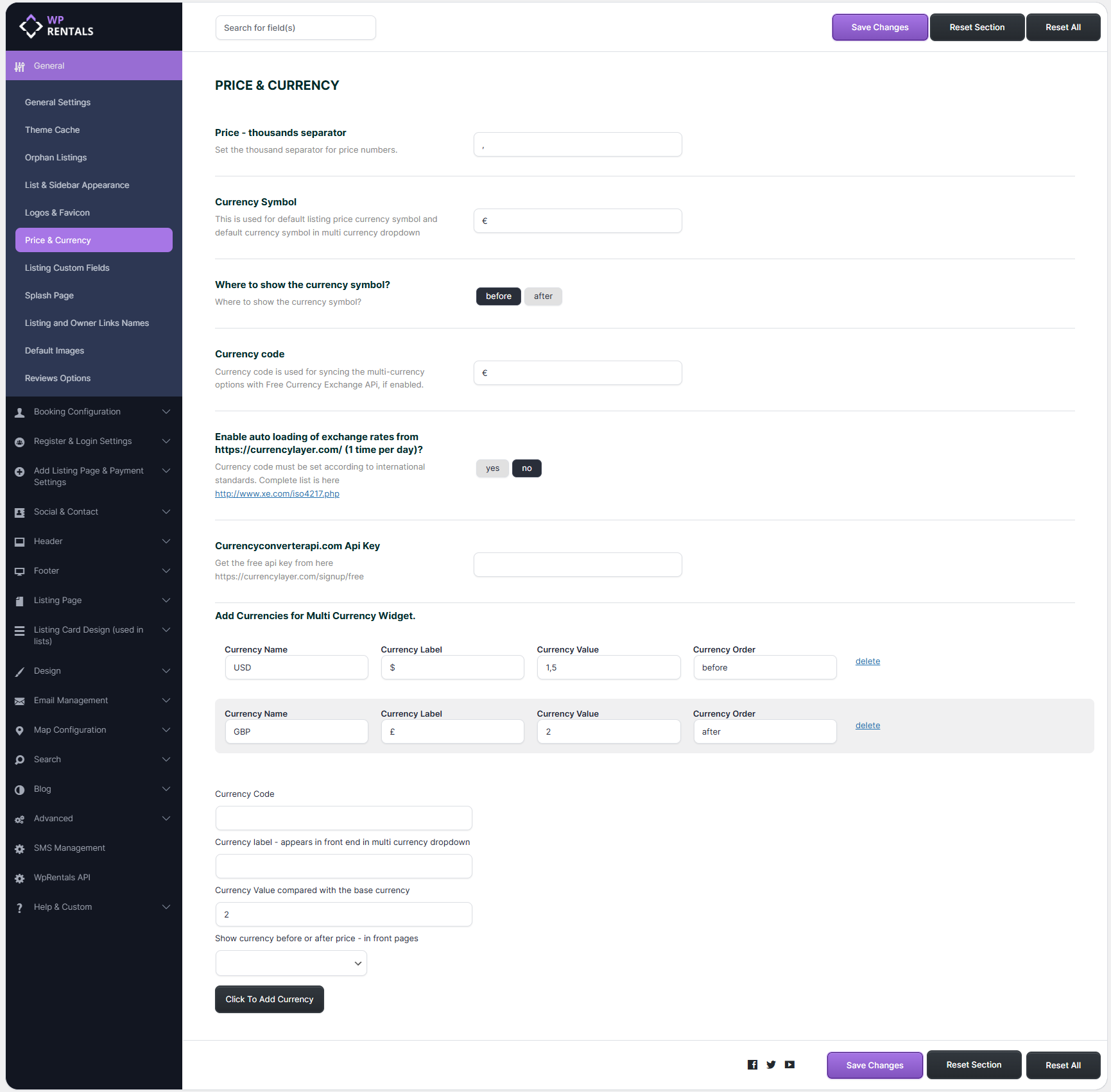
Currency Code for Multi Currency Widget
The Currency Code for Multi Currency Widget must match your website main currency.
Use a valid ISO 4217 currency code, not a symbol and not a custom label.
Examples:
- USD for US Dollar
- EUR for Euro
- GBP for British Pound
- AED for UAE Dirham
This code is important because it is used as the base currency for calculating all extra currencies added to the currency selector.
Automatic Exchange Rate Updates
WPRentals can update exchange rates automatically once per day if the automatic exchange rate option is enabled and configured correctly.
To use automatic exchange rate updates, check the following:
- Enable the option for automatic exchange rate loading in Theme Options > Price & Currency.
- Add the required API key in the theme options.
- Make sure the main currency code is a valid ISO 4217 currency code.
- Make sure all extra currency codes are valid ISO 4217 currency codes.
- Save the settings.
You can get an API key from:
https://currencylayer.com/signup/free
If Currency Value Fields Become Empty
If the Currency Value fields become empty after being saved, check the automatic exchange-rate setup first.
This can happen when Auto-Update Exchange Rates runs and the API response returned to the website is empty, invalid, blocked, or based on a wrong currency code.
Step 1: Check the Main Currency Code
Go to:
Theme Options > Price & Currency
Check the field:
Currency Code for Multi Currency Widget
This must be your website main currency and must be a valid ISO 4217 code.
Correct examples:
- USD
- EUR
- GBP
- AED
Wrong examples:
- $
- €
- Dollar
- Euro
- Any custom text that is not a real currency code
Step 2: Check the Extra Currency Codes
Each currency added to the Multiple Currency settings must also use a valid ISO 4217 currency code.
Each extra currency must have:
- Currency Code
- Currency Label
- Currency Value
- Position of Symbol
Step 3: Check the API Key and API Response
If Auto-Update Exchange Rates is enabled, check that:
- The CurrencyLayer API key is valid and active.
- The CurrencyLayer account has not reached its request limit.
- The API plan supports the currencies you are using.
- The API returns valid exchange-rate values, not an error response.
- The server is not blocking outgoing requests to the currency API.
- A firewall, hosting rule, security plugin, or maintenance plugin is not blocking the API request.
https://currencylayer.com/signup/free
Step 4: Save Correct Values and Test
- Correct the main currency code.
- Correct the extra currency codes.
- Add or correct the Currency Value fields.
- Save Theme Options.
- Run or wait for the next currency auto-update.
- Check if the Currency Value fields remain saved.
Temporary Workaround
If the automatic update keeps clearing the values, disable Auto-Update Exchange Rates and add the currency values manually.
Manual values will remain saved as long as the automatic exchange-rate update does not overwrite them again.
What to Send to Support
If you need support to check why the currency values become empty, please send:
- A screenshot of Theme Options > Price & Currency.
- A screenshot showing if Auto-Update Exchange Rates is enabled.
- The main website currency code.
- The extra currency codes added in the Multiple Currency settings.
- Confirmation that the main currency code and all extra currency codes are valid ISO 4217 codes.
- A screenshot from your CurrencyLayer account showing the API key/account is active.
- Confirmation that the API request is not blocked by hosting, firewall, security plugin, maintenance mode, or a third-party plugin.
- The date/time when the currency values became empty.
- WordPress debug log or hosting PHP error log, if available.
Add Currencies Manually
In Theme Options > Price & Currency, add each currency you want to show in the currency selector.
For each currency, configure:
- Currency Code – the currency code, for example GBP, EUR, or USD.
- Currency Label – the symbol or label shown on the front end, for example £, €, or $.
- Currency Value – the exchange rate compared with your website main currency.
- Position of Symbol – choose if the symbol shows before or after the price.
How to Understand Currency Value
The Currency Value is the exchange rate compared with your website main currency.
Example:
- Your main website currency is USD.
- You want to add EUR.
- If 1 USD equals 0.92 EUR, add 0.92 as the value for EUR.
Another example:
- Your main website currency is EUR.
- You want to add USD.
- If 1 EUR equals 1.09 USD, add 1.09 as the value for USD.
Choose Where to Display the Currency Selector
After the currency setup is complete, choose where you want the selector to appear.
WPRentals has two separate display methods:
| Where you want to show it | What to use | Where to add it |
|---|---|---|
| Default widget areas, such as Top Bar, Sidebar, Footer widgets, or Header Widget Area | Wp Estate – Multiple Currency Widget | Appearance > Widgets |
| Custom Header or Footer template created with WPRentals Studio and Elementor | Dedicated Elementor currency dropdown widget | Edit the Studio Header/Footer template with Elementor and add the currency dropdown widget from the Elementor widgets panel |
Option 1: Add the WordPress Multiple Currency Widget
Use this option when your website uses the default WPRentals widget areas.
This widget is the WordPress widget named:
Wp Estate – Multiple Currency Widget
It is added from:
Appearance > Widgets
- Go to Appearance > Widgets.
- Locate Wp Estate – Multiple Currency Widget.
- Add it to the widget area where you want it to appear.
- Save the widget area.
You can add this WordPress widget to widget-ready areas such as:
- Header Widget Area
- Top Bar Left or Top Bar Right
- Sidebar
- Footer Column
Classic Widgets View
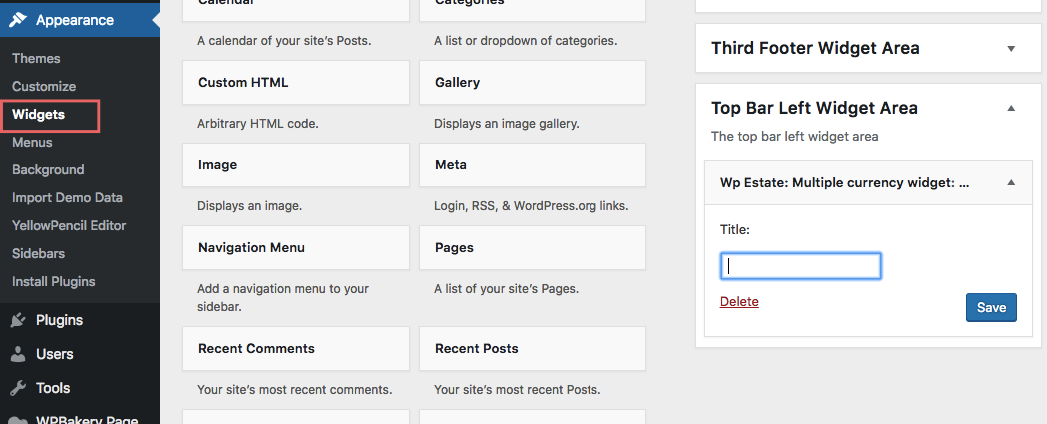
Block Widgets View

Option 2: Add the Currency Dropdown in a WPRentals Studio Template
Use this option when your website uses a custom Header or Footer created with WPRentals Studio and Elementor.
In this case, do not add the WordPress widget from Appearance > Widgets for that header/footer area. Instead, edit the active Studio template with Elementor and add the dedicated currency dropdown widget available for Elementor templates.
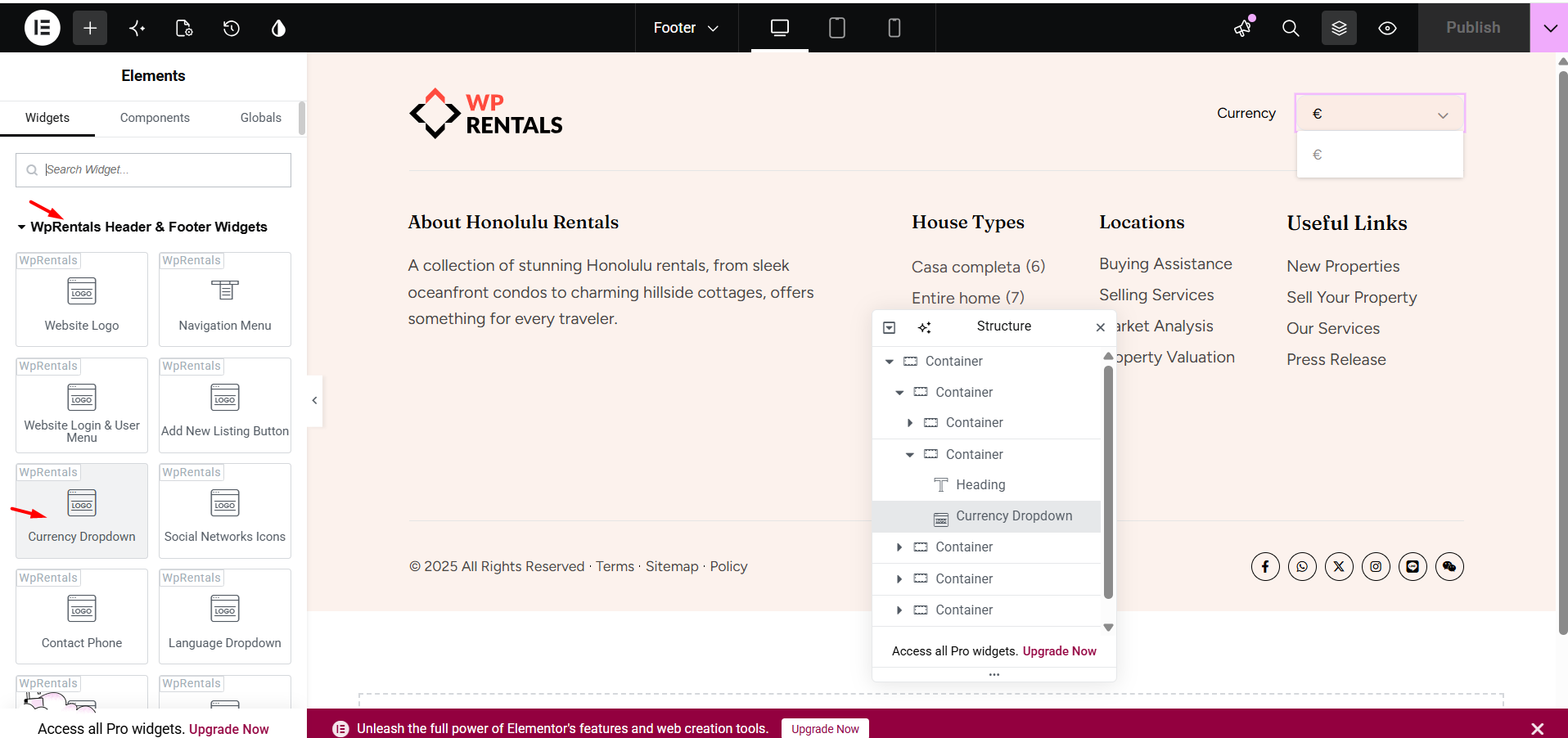
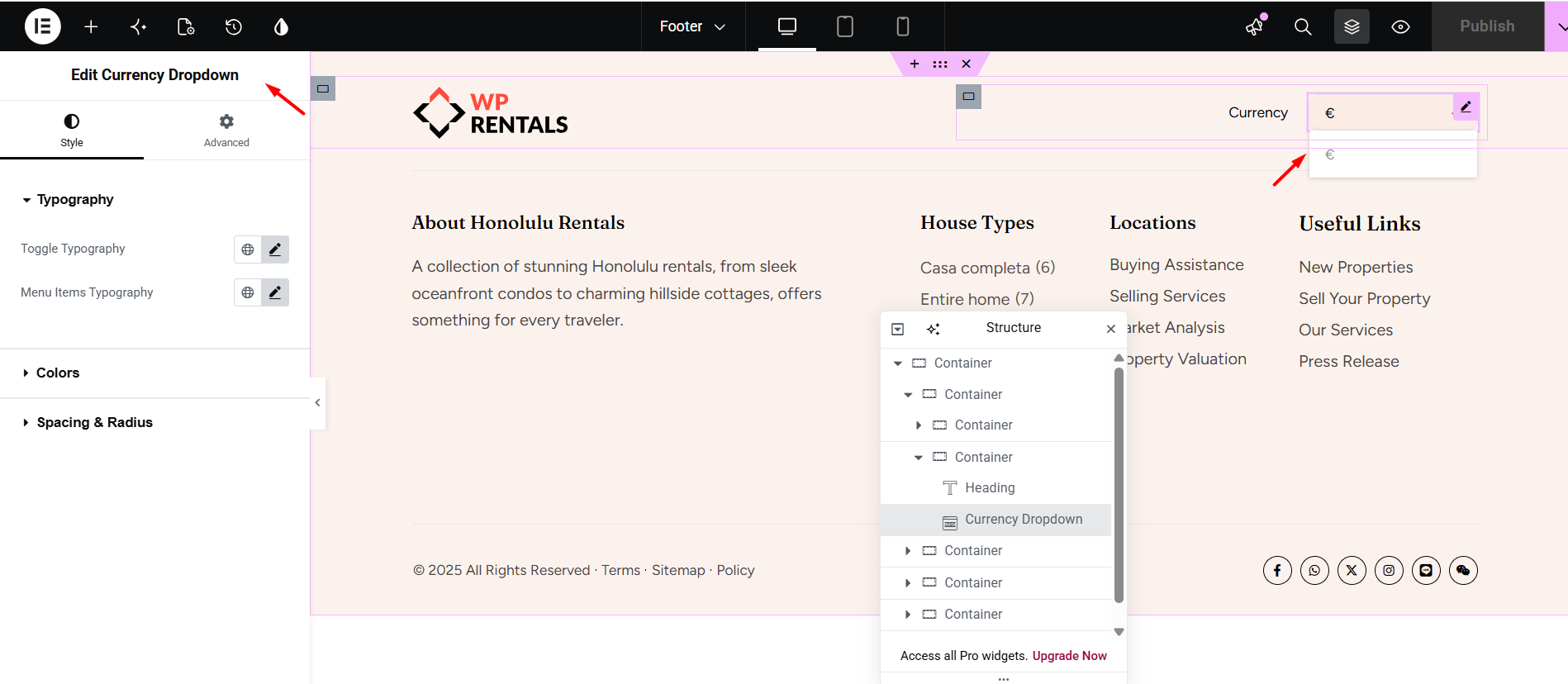
Front-End Behavior
On the front end, visitors can select a currency from the dropdown.
After a currency is selected:
- Property prices are displayed in the selected currency.
- Prices on listing cards, search results, and single property pages can show the selected currency.
- The conversion uses the exchange rates configured in Theme Options.
- The selected currency is remembered with session or cookie storage.
- Checkout, invoices, deposits, and booking payments remain in the main website currency.


Cookies and Cache Notes
The selected currency is stored with session or cookie storage.
Because of this, cache plugins can affect how prices are displayed if the cache serves the same saved page to all visitors.
If the currency selector does not update prices correctly, or if prices show the wrong currency, check the cache setup.
Common cache-related issues include:
- The page is cached before the user selects a currency.
- The cache plugin does not vary cache by currency cookie/session.
- Minification or JavaScript optimization blocks the currency switcher script.
- Server cache or CDN cache serves old price HTML.
How to use a cache plugin with the Multi-Currency widget dropdown
Important Notes
- The Multiple Currency feature changes displayed prices only.
- Booking payments are processed in the website main currency.
- Invoices, deposits, and checkout amounts use the main currency.
- The main currency code must be a valid ISO 4217 currency code.
- Do not use only a symbol in the main currency code field.
- Each extra currency needs a code, label, value, and symbol position.
- Exchange rates are configured manually or updated automatically if the API setup is correct.
- If automatic exchange rates are enabled, the Currency Value fields can be overwritten once per day by the API response.
- If the API request fails or returns invalid/empty data, the currency values may become empty.
- If values become empty after the daily update, check the API response and currency codes first, not cache.
- Wrong exchange values will show wrong converted prices.
- The selected visitor currency is stored with session or cookie storage.
- Cache plugins can affect the currency switcher display if they do not handle the currency cookie/session correctly.
- For default widget areas, use the WordPress widget named Wp Estate – Multiple Currency Widget from Appearance > Widgets.
- For WPRentals Studio Header or Footer templates, use the dedicated Elementor currency dropdown widget inside the Studio template.